
🎉NEWCapSolver for AI agents-MCP, agent tools, and SDK integrations

Ethan Collins
AI Agent Workflow Engineer
Published Sep 01, 2026
Updated Sep 01, 2026 · min read
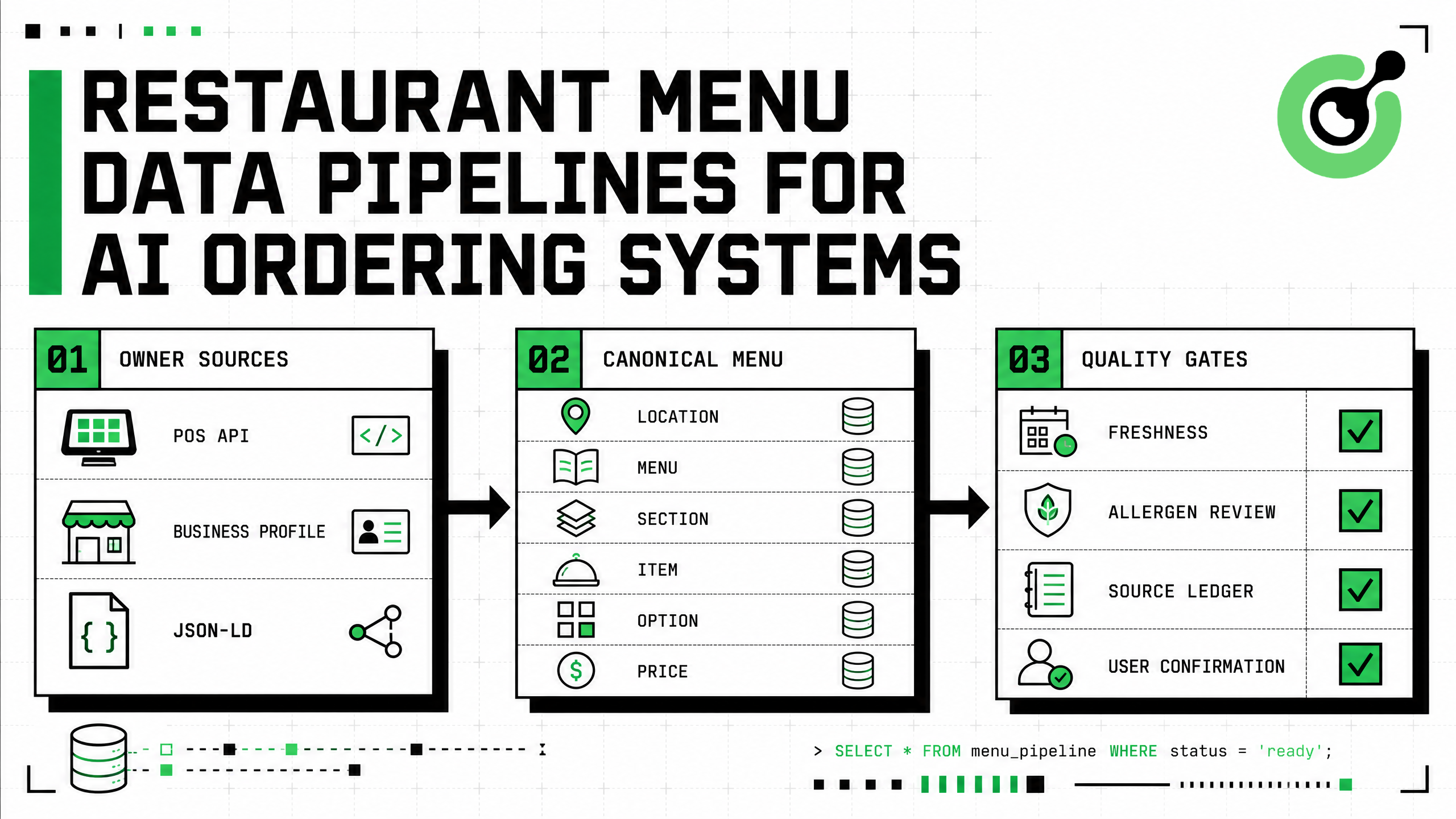
Restaurant menu data for AI ordering systems should be built as a provenance-first data product, not as a collection of dish names and prices. The most reliable pipeline starts with owner-controlled sources such as Google Business Profile Food Menus, POS menu APIs, exports, and first-party structured data. It then normalizes location, menu, section, item, option, price, currency, language, dietary labels, allergens, availability, and observation time into a stable schema. Each field must remain traceable to its source, especially when an AI system answers questions, compares options, or prepares an order. Rendered-page collection is a lower-priority fallback and should operate only with permission, rate limits, and strict challenge handling. This guide shows how to design that pipeline from ingestion through validation and review.
A restaurant rarely has one timeless menu. The data can vary by:
An AI ordering system that flattens these differences can quote the wrong price, omit a required option, or misstate dietary information.
The CapSolver web-scraping blog provides related extraction guidance, while the web-scraping FAQ explains source and operational considerations.
Start with the most authoritative and structured source.
| Priority | Source | Strength | Main control |
|---|---|---|---|
| 1 | Owner or POS API | Structured and authoritative | Authentication and contract scope |
| 2 | Owner export or feed | Stable batch ingestion | Version and freshness metadata |
| 3 | Business Profile menu API | Structured location-level menu data | Account and location authorization |
| 4 | First-party JSON-LD or embedded data | Public and machine-readable | Schema validation and source URL |
| 5 | Authorized rendered page | Useful when no feed exists | Rate limits, page state, evidence |
| 6 | OCR or image parsing | Last resort | Low confidence and mandatory review |
Do not treat third-party aggregators as equivalent to the restaurant's own menu.
Google Business Profile's FoodMenus model defines menus, sections, items, labels, options, price, cuisine, allergens, dietary restrictions, nutrition, ingredients, preparation methods, portion size, and media keys.
Google's food-menu update guide also documents location eligibility and the owner-controlled read-and-update flow.
Schema.org's Menu type describes a structured menu with hasMenuSection and hasMenuItem relationships.
Toast's Menus API guide recommends checking metadata before retrieving menus to determine whether cached data is stale.
These models support a common design: preserve hierarchy and freshness instead of flattening everything into one text block.
from datetime import datetime
from decimal import Decimal
from typing import Literal
from pydantic import BaseModel, Field, HttpUrl

class Money(BaseModel):
    currency: str = Field(min_length=3, max_length=3)
    amount: Decimal
    tax_included: bool | None = None

class Evidence(BaseModel):
    source_type: Literal[
        "OWNER_API",
        "OWNER_EXPORT",
        "BUSINESS_PROFILE",
        "JSON_LD",
        "AUTHORIZED_PAGE",
        "IMAGE_REVIEW",
    ]
    source_url: HttpUrl | None = None
    source_record_id: str | None = None
    observed_at: datetime
    source_modified_at: datetime | None = None
    content_hash: str
    language: str

class MenuOption(BaseModel):
    option_id: str
    name: str
    price_delta: Money | None = None
    available: bool | None = None

class MenuItem(BaseModel):
    item_id: str
    restaurant_id: str
    location_id: str
    menu_id: str
    section_id: str
    name: str
    description: str | None = None
    base_price: Money | None = None
    options: list[MenuOption] = []
    dietary_labels: list[str] = []
    allergens: list[str] = []
    ingredients: list[str] = []
    available: bool | None = None
    evidence: Evidence
Keep source evidence attached to each record. A menu-level timestamp is not enough when individual items come from different sources.
class Restaurant(BaseModel):
    restaurant_id: str
    brand_name: str
    legal_name: str | None = None

class Location(BaseModel):
    location_id: str
    restaurant_id: str
    address_line: str
    city: str
    region: str | None = None
    postal_code: str | None = None
    country_code: str
    timezone: str

class Menu(BaseModel):
    menu_id: str
    location_id: str
    name: str
    service_modes: list[str]
    dayparts: list[str]
    valid_from: datetime | None = None
    valid_until: datetime | None = None
    language: str
A menu ID should represent a specific location and context. Do not combine lunch and dinner prices or merge delivery and dine-in menus without explicit rules.
from hashlib import sha256
import json


def canonical_hash(payload: dict) -> str:
    encoded = json.dumps(
        payload,
        sort_keys=True,
        ensure_ascii=False,
        separators=(",", ":"),
    ).encode("utf-8")
    return sha256(encoded).hexdigest()

async def ingest_owner_menu(api, location_id: str) -> list[MenuItem]:
    metadata = await api.get_menu_metadata(location_id)
    if metadata.not_modified:
        return []

    payload = await api.get_menu(location_id)
    observed_at = utc_now()
    records = []

    for menu in payload["menus"]:
        for section in menu.get("sections", []):
            for item in section.get("items", []):
                records.append(
                    normalize_owner_item(
                        location_id=location_id,
                        menu=menu,
                        section=section,
                        item=item,
                        observed_at=observed_at,
                        content_hash=canonical_hash(item),
                    )
                )
    return records
Use conditional requests, metadata endpoints, ETags, or source modification times when available. Avoid downloading an unchanged menu repeatedly.
Menu price normalization should preserve the original representation.
class NormalizedPrice(BaseModel):
    amount: Decimal
    currency: str
    original_text: str | None = None
    price_type: Literal[
        "FIXED",
        "FROM",
        "RANGE",
        "MARKET_PRICE",
        "INCLUDED",
        "UNKNOWN",
    ]
    upper_amount: Decimal | None = None


def normalize_price(raw: dict, currency: str) -> NormalizedPrice | None:
    if raw.get("market_price"):
        return NormalizedPrice(
            amount=Decimal("0"),
            currency=currency,
            original_text=raw.get("display"),
            price_type="MARKET_PRICE",
        )
    if raw.get("min") is not None and raw.get("max") is not None:
        return NormalizedPrice(
            amount=Decimal(str(raw["min"])),
            upper_amount=Decimal(str(raw["max"])),
            currency=currency,
            original_text=raw.get("display"),
            price_type="RANGE",
        )
    if raw.get("amount") is not None:
        return NormalizedPrice(
            amount=Decimal(str(raw["amount"])),
            currency=currency,
            original_text=raw.get("display"),
            price_type="FIXED",
        )
    return None
Never convert “market price” into zero for downstream display. The sentinel should remain distinct from a real numeric price.
class ModifierChoice(BaseModel):
    choice_id: str
    name: str
    price_delta: Money | None = None
    available: bool | None = None

class ModifierGroup(BaseModel):
    group_id: str
    name: str
    minimum_selections: int
    maximum_selections: int
    choices: list[ModifierChoice]

class OrderableItem(MenuItem):
    modifier_groups: list[ModifierGroup] = []
An ordering system needs selection constraints, not just option names. “Choose one size” and “choose up to three toppings” are different rules.
class LocalizedText(BaseModel):
    language: str
    value: str
    source_value: str
    translated: bool = False
    translation_model: str | None = None

class LocalizedMenuItem(BaseModel):
    item_id: str
    names: list[LocalizedText]
    descriptions: list[LocalizedText]
Do not overwrite original text with a generated translation. Preserve the source language, translated flag, model version, and review status.
Google's FoodMenus model supports allergens and dietary restrictions, but downstream systems should only present claims supported by the source.
The U.S. Food and Drug Administration's food-allergy guidance illustrates why allergen information is safety-relevant.
class SafetyClaim(BaseModel):
    claim: str
    source_type: str
    explicit_source_text: str
    confidence: float
    reviewed: bool
    reviewer_id: str | None = None


def allow_safety_claim(claim: SafetyClaim) -> bool:
    return (
        claim.source_type in {"OWNER_API", "OWNER_EXPORT", "BUSINESS_PROFILE"}
        and bool(claim.explicit_source_text.strip())
        and claim.reviewed
    )
Do not infer “nut-free,” “gluten-free,” “halal,” “kosher,” or similar claims from ingredients, cuisine, images, or an AI model's assumptions.
import json
from bs4 import BeautifulSoup


def extract_json_ld_menu(html: str) -> list[dict]:
    soup = BeautifulSoup(html, "html.parser")
    menus = []
    for script in soup.select('script[type="application/ld+json"]'):
        try:
            payload = json.loads(script.string or "")
        except json.JSONDecodeError:
            continue

        nodes = payload if isinstance(payload, list) else [payload]
        for node in nodes:
            if not isinstance(node, dict):
                continue
            if node.get("@type") == "Menu":
                menus.append(node)
            graph = node.get("@graph", [])
            menus.extend(
                entry
                for entry in graph
                if isinstance(entry, dict) and entry.get("@type") == "Menu"
            )
    return menus
Validate the schema and keep the source URL, observed time, and content hash with each normalized record.
Rendered-page collection may be necessary when an authorized restaurant publishes no API, feed, or structured data. Before navigating:
The CapSolver legal web-scraping guide provides additional compliance context.
A first-party menu page may present a supported challenge during an authorized collection run. CapSolver can fit this narrow part of the pipeline after API and structured-data options are exhausted.
class CollectionDecision(BaseModel):
    source_type: str
    authorized: bool
    public_fields_only: bool
    challenge_type: str | None = None
    rate_limit_ok: bool


def may_use_challenge_service(decision: CollectionDecision) -> bool:
    return (
        decision.source_type == "AUTHORIZED_PAGE"
        and decision.authorized
        and decision.public_fields_only
        and decision.rate_limit_ok
        and decision.challenge_type in {
            "RECAPTCHA_V2",
            "RECAPTCHA_V3",
            "CLOUDFLARE_TURNSTILE",
            "CLOUDFLARE_CHALLENGE",
        }
    )
The CapSolver products page helps confirm supported task families. Never interpret a challenge as missing menu data.
class SourceLedgerEntry(BaseModel):
    run_id: str
    restaurant_id: str
    location_id: str
    source_type: str
    source_url: str | None
    permission_basis: str
    observed_at: datetime
    source_modified_at: datetime | None
    record_count: int
    content_hash: str
    challenge_observed: bool
    human_review_required: bool
The ledger lets a reviewer answer where a price came from, when it was observed, and which pipeline version produced it.
from datetime import timedelta

FRESHNESS = {
    "availability": timedelta(minutes=15),
    "price": timedelta(hours=6),
    "description": timedelta(days=7),
    "dietary_labels": timedelta(days=7),
    "allergens": timedelta(days=1),
    "media": timedelta(days=30),
}


def is_fresh(field: str, observed_at: datetime, now: datetime) -> bool:
    maximum_age = FRESHNESS[field]
    return now - observed_at <= maximum_age
These are example internal policies, not universal facts. Set limits according to source behavior, contract terms, user expectations, and risk.
class MenuChange(BaseModel):
    restaurant_id: str
    location_id: str
    item_id: str
    field: str
    before: object
    after: object
    source_before: str
    source_after: str
    requires_review: bool

HIGH_RISK_FIELDS = {"allergens", "dietary_labels", "availability", "price"}


def compare_items(previous: MenuItem, current: MenuItem) -> list[MenuChange]:
    changes = []
    for field in [
        "name",
        "description",
        "base_price",
        "options",
        "dietary_labels",
        "allergens",
        "available",
    ]:
        before = getattr(previous, field)
        after = getattr(current, field)
        if before != after:
            changes.append(
                MenuChange(
                    restaurant_id=current.restaurant_id,
                    location_id=current.location_id,
                    item_id=current.item_id,
                    field=field,
                    before=before,
                    after=after,
                    source_before=previous.evidence.content_hash,
                    source_after=current.evidence.content_hash,
                    requires_review=field in HIGH_RISK_FIELDS,
                )
            )
    return changes
Do not alert on ordering differences or whitespace-only changes. Compare normalized records.
The AI layer should answer from verified records and never place an order without a separate confirmation step.
class OrderProposal(BaseModel):
    location_id: str
    item_id: str
    option_ids: list[str]
    quoted_total: Money
    menu_observed_at: datetime
    source_record_id: str
    safety_claims_reviewed: bool


def may_present_for_confirmation(proposal: OrderProposal, now: datetime) -> bool:
    return (
        is_fresh("price", proposal.menu_observed_at, now)
        and proposal.safety_claims_reviewed
        and proposal.quoted_total.amount >= 0
    )
Present the location, item, options, quantity, subtotal, fees, taxes, source time, and cancellation terms before asking for explicit user confirmation.
| Pipeline design | Source quality | Freshness | Safety | Recommendation |
|---|---|---|---|---|
| Flattened page text | Low | Unknown | Low | Avoid |
| Third-party aggregate only | Variable | Variable | Medium | Use cautiously |
| Owner APIs plus normalized ledger | High | High | High | Preferred |
| First-party page fallback with review | Medium | Measurable | Medium to high | Use when authorized |
The preferred architecture starts with owner-controlled structured sources and keeps evidence attached to each field.
class QualityResult(BaseModel):
    accepted: bool
    reasons: list[str]


def validate_item(item: MenuItem) -> QualityResult:
    reasons = []
    if not item.name.strip():
        reasons.append("missing_name")
    if item.base_price and item.base_price.amount < 0:
        reasons.append("negative_price")
    if item.evidence.source_type == "IMAGE_REVIEW":
        reasons.append("image_source_requires_review")
    if item.allergens and item.evidence.source_type not in {
        "OWNER_API",
        "OWNER_EXPORT",
        "BUSINESS_PROFILE",
    }:
        reasons.append("allergen_source_requires_review")
    return QualityResult(accepted=not reasons, reasons=reasons)
Quarantine failed records instead of silently repairing them with generated text.
Track:
Do not log API keys, cookies, private customer data, payment data, or full browser storage state.
The CapSolver AI and automation FAQ can support tool and approval-boundary design.
import pytest


def test_market_price_is_not_zero_price():
    value = normalize_price(
        {"market_price": True, "display": "Market price"},
        "USD",
    )
    assert value.price_type == "MARKET_PRICE"
    assert value.original_text == "Market price"


def test_unreviewed_allergen_claim_is_blocked():
    claim = SafetyClaim(
        claim="contains peanuts",
        source_type="JSON_LD",
        explicit_source_text="contains peanuts",
        confidence=1.0,
        reviewed=False,
        reviewer_id=None,
    )
    assert allow_safety_claim(claim) is False
Also test currency precision, location separation, multilingual labels, option constraints, stale prices, duplicated item IDs, source priority, challenge-page classification, and order-confirmation gates.
Bonus Code: Use code WEBS at CapSolver Dashboard to get an extra 5% bonus on every recharge.
The CapSolver CAPTCHA-solving FAQ provides additional guidance for authorized challenge steps.
Collect restaurant menu data only from owner-controlled, licensed, public, or explicitly authorized sources. Respect API agreements, terms, robots directives, rate limits, copyright, privacy, and database rights. Do not collect customer, payment, loyalty, or private order data. Do not infer allergens or dietary suitability. An AI system should present source time and uncertainty, and a human should confirm consequential choices.
Restaurant menu data for AI ordering systems needs hierarchy, provenance, freshness, and safety controls. Prefer owner APIs and POS feeds, preserve location and menu context, normalize item options and prices, keep language variants linked, and require explicit evidence for allergens and dietary labels. Use authorized rendered pages only as a controlled fallback, and treat supported challenge handling as one narrow infrastructure step—not as permission to access a source.
Build an authorized pipeline with CapSolver where supported challenges interrupt approved menu collection, then verify source, menu state, field provenance, and freshness before an AI system uses the result.
Use an owner-authorized API, POS feed, or export first. Business Profile menus and first-party structured data are useful secondary sources.
Include restaurant, location, menu, section, item, option, price, currency, language, dietary labels, allergens, availability, source, and observation time.
It should not. Present those claims only when the source states them explicitly and the relevant review policy is satisfied.
Set field-specific policies. Availability and prices usually need shorter limits than descriptions or media, but the exact interval depends on source behavior and risk.
CapSolver can handle a supported challenge on an authorized first-party page when no approved structured source is available. The result still needs page and data validation.
Ethan Collins
AI Agent Workflow Engineer
Building clearer handoffs between AI agents and tools.
ABOUT THE AUTHOR
Learn scalable Rust web scraping architecture with reqwest, scraper, async scraping, headless browser scraping, proxy rotation, and compliant CAPTCHA handling.

Learn the best techniques to scrape job listings without getting blocked. Master Indeed scraping, Google Jobs API, and web scraping API with CapSolver.