🎉NEWCapSolver for AI agents-MCP, agent tools, and SDK integrations

Lucas Mitchell
Automation Engineer
Published Jun 10, 2026
Updated Jun 10, 2026 · min read
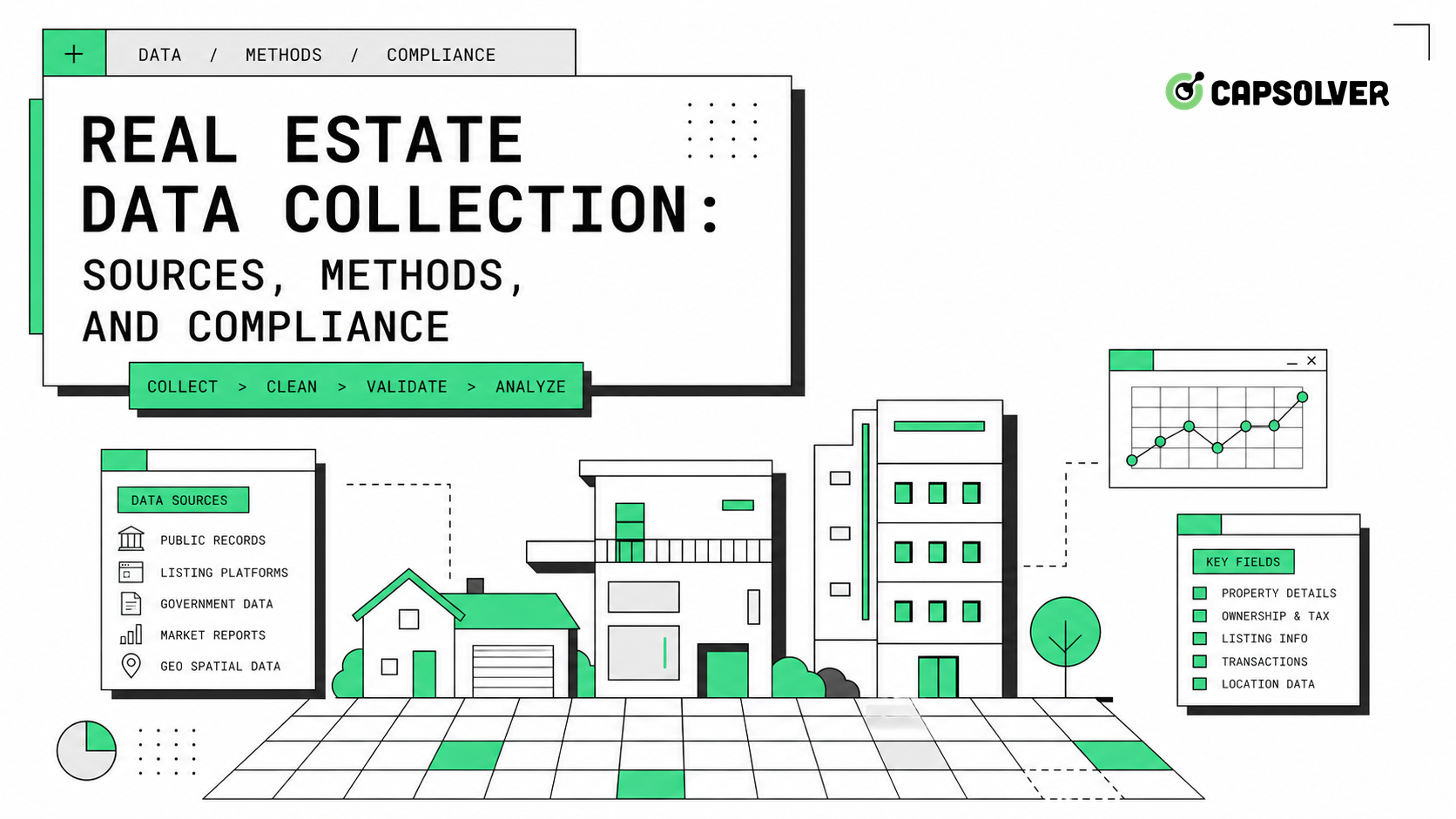
Real estate data collection is the process of gathering, cleaning, and organizing property, market, ownership, transaction, and neighborhood data for analysis. The goal is not just to collect more records. The goal is to build a reliable dataset that can support pricing models, lead generation, investment research, portfolio monitoring, appraisal workflows, and market intelligence. A strong workflow combines official public datasets, licensed MLS or listing feeds, government records, geospatial data, and carefully governed web collection. CapSolver is relevant when an authorized data workflow needs to handle CAPTCHA or traffic validation without turning collection into uncontrolled retry behavior.
Real estate data collection usually covers five groups of information. Property attributes describe the asset itself: address, parcel ID, property type, bedrooms, bathrooms, square footage, lot size, year built, zoning, and building class. Market data describes pricing and demand: listing price, sale price, rent estimate, days on market, inventory, price reductions, and absorption trends. Ownership and transaction data describe who owns the property and how it has changed hands. Permit and construction data show renovation, new construction, and improvement activity. Location data adds school zones, commute patterns, flood risk, amenities, census demographics, and neighborhood boundaries.
A useful real estate dataset should explain both the property and the market around it. A single listing price is not enough. Analysts need comparable sales, listing history, neighborhood context, and data quality flags. For example, a multifamily investor may need rent comps and permit history, while a brokerage platform may need active listings, open-house times, and agent metadata. A lender may focus on property valuation, ownership, tax history, and regulatory risk.
The best real estate data collection strategy starts with authoritative sources. Government data is often slower than listing data, but it is valuable because it is traceable and structured. The U.S. Census Bureau provides APIs for datasets covering housing characteristics, geography, construction, and demographic context; its Census API catalog is a useful starting point for housing and local-market enrichment.
Industry standards also matter. MLS and brokerage ecosystems often use standardized fields so data can move between systems. The RESO Data Dictionary helps real estate teams align listing fields, property attributes, and transaction concepts across markets. If your data model ignores industry vocabulary, every integration becomes more expensive.
Market indicators add another layer. The National Association of Realtors publishes existing-home sales data, while the Federal Reserve Bank of St. Louis organizes many public housing time series in FRED housing data. These sources help teams compare property-level signals against wider housing-market trends.
Web collection can fill gaps when data is public, permitted, and not available through a better API or licensed feed. A brokerage may monitor public listing changes. An investor may track asking rents. A proptech company may collect open-house schedules, broker descriptions, or amenity details. This is where real estate data collection becomes operationally sensitive.
Before collecting from a website, review access rules, terms, robots guidance, and local laws. Do not collect private, restricted, account-only, or personal data without authorization. Technical access does not create permission. If a site offers an API, partner feed, or licensing path, use that before scraping. A web scraping FAQ is useful for thinking through responsible collection boundaries, and a basic web scraping workflow should include rate limits, retries, logging, and stop conditions.
A practical real estate data collection schema should separate raw fields from normalized fields. Raw fields preserve what the source provided. Normalized fields make records comparable.
Important property fields include full address, parsed address, latitude, longitude, parcel ID, property type, building size, lot size, year built, units, bedrooms, bathrooms, parking, HOA fees, tax assessment, zoning, and last sale date. Important listing fields include listing ID, source URL, listing status, price, rent, price history, listing date, days on market, agent, broker, photos, description, open-house times, and update timestamp. Important market fields include median price, inventory, absorption rate, rent per square foot, sale-to-list ratio, and comparable-property references.
Do not treat address matching as a minor detail. Real estate data collection often fails because the same property appears under slightly different addresses. Normalize street suffixes, apartment numbers, geocodes, and parcel identifiers. Keep confidence scores so downstream users know whether a match is exact, probable, or unresolved.
Real estate data collection needs quality checks at every stage. Deduplication is the first control. The same property may appear in public records, MLS feeds, aggregator sites, rental platforms, and county tax data. Merge records carefully and preserve source lineage. A low-confidence merge can corrupt pricing models.
Freshness is the second control. Listing status changes quickly. A property can move from active to pending to sold within days. A stale active listing can mislead buyers, investors, and internal teams. Store first_seen, last_seen, last_changed, and source update time. Use source-specific refresh schedules instead of crawling every site at the same rate.
Validation is the third control. Flag impossible values such as negative square footage, a sale date in the future, a property with zero price when the source requires price, or a building year outside a reasonable range. Cross-check property type, unit count, and lot size against public records when possible.
Real estate websites often use traffic validation because listing pages are commercially valuable and frequently scraped. A responsible real estate data collection workflow should detect these states clearly. If a CAPTCHA, Cloudflare Turnstile, rate limit, or hard block appears, the collector should stop normal scraping behavior and return a structured state.
For permitted public-data workflows, a CAPTCHA handling process should be explicit rather than hidden inside a retry loop. If the workflow uses rotating networks, review proxy quality and keep sessions stable. Random IP changes during a single listing session can make validation harder. If a site shows repeated challenges, slow down, reduce concurrency, or use an approved data access route.
Redeem Your CapSolver Bonus Code
Boost your automation budget instantly!
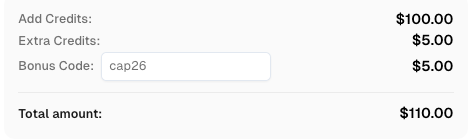
Use bonus code CAP26 when topping up your CapSolver account to get an extra 5% bonus on every recharge — with no limits.
Redeem it now in your CapSolver Dashboard
Real estate data collection can touch sensitive areas. Public property records are not the same as unrestricted personal profiling. Ownership data, phone numbers, emails, tenant details, financial distress signals, and occupancy indicators require careful handling. Build a data policy before collecting at scale.
A responsible policy should define allowed sources, prohibited fields, retention periods, access controls, and deletion workflows. It should also define when to stop collection. A hard 403, login wall, account restriction, or explicit denial should be treated as a stop signal. If your team collects data for lending, insurance, tenant screening, or advertising, legal review is especially important because housing data can intersect with fair housing, privacy, and consumer-protection rules.
A clean workflow has six steps. First, define the business question. A pricing model, lead list, rental comp engine, and investment dashboard need different fields. Second, map allowed sources. Choose APIs, licensed feeds, public records, and permitted web sources. Third, design the schema. Use stable identifiers, source lineage, and quality flags. Fourth, collect incrementally. Avoid full recrawls when change detection is enough. Fifth, normalize and validate. Standardize addresses, property types, currencies, areas, and timestamps. Sixth, monitor drift. Source layouts, field meanings, and market conditions change.
Automation should be observable. Store crawl status, source response, detected challenge state, record count, validation errors, and upload time. If collection fails, the system should explain whether the cause was source downtime, schema change, rate limit, CAPTCHA, parser error, or missing permission.
The biggest mistake is collecting before defining the use case. Real estate data collection can produce huge datasets that are still not useful. A model trained on stale listings or duplicated properties will produce poor recommendations. A lead-generation workflow based on noisy ownership data will waste sales time. A market dashboard that mixes active listings with sold properties without clear status labels will mislead users.
Another mistake is relying on one source. Official records may be accurate but delayed. Listing sites may be fresh but inconsistent. Broker feeds may be structured but limited by license. Web data may be rich but fragile. The best systems combine sources and show confidence.
A third mistake is ignoring operational ethics. Aggressive collection can overload sites, trigger blocks, and create legal risk. A measured, documented, permission-aware workflow is more durable.
Real estate data collection is valuable when it is accurate, current, traceable, and lawful. Start with a clear use case, use authoritative sources where possible, normalize property identifiers, validate every field, and treat web collection as a governed workflow rather than a brute-force task. For authorized automation where traffic validation or CAPTCHA appears during public data collection, CapSolver can be part of a controlled collection process.
Real estate data collection is the process of gathering property, listing, transaction, ownership, market, and location data from approved sources for analysis or business workflows.
A strong dataset usually includes address, parcel ID, price, listing status, property type, square footage, lot size, year built, tax data, transaction history, rent signals, and location context.
It depends on the source, terms, jurisdiction, data type, and collection method. Use APIs or licensed feeds when available, respect access rules, and do not collect private or restricted data without authorization.
Use address normalization, parcel matching, source lineage, deduplication, freshness checks, validation rules, and confidence scores for merged records.
Real estate sites often protect listing data from high-volume automated traffic. A responsible collector should detect CAPTCHA or traffic validation, slow down, and continue only when the workflow is authorized.
Lucas Mitchell
Automation Engineer
Helping browser automation recover and continue.
ABOUT THE AUTHOR
Learn scalable Rust web scraping architecture with reqwest, scraper, async scraping, headless browser scraping, proxy rotation, and compliant CAPTCHA handling.
Learn the best techniques to scrape job listings without getting blocked. Master Indeed scraping, Google Jobs API, and web scraping API with CapSolver.