
🎉NEWCapSolver for AI agents-MCP, agent tools, and SDK integrations

Ethan Collins
AI Agent Workflow Engineer
Published Aug 26, 2026
Updated Aug 27, 2026 · min read
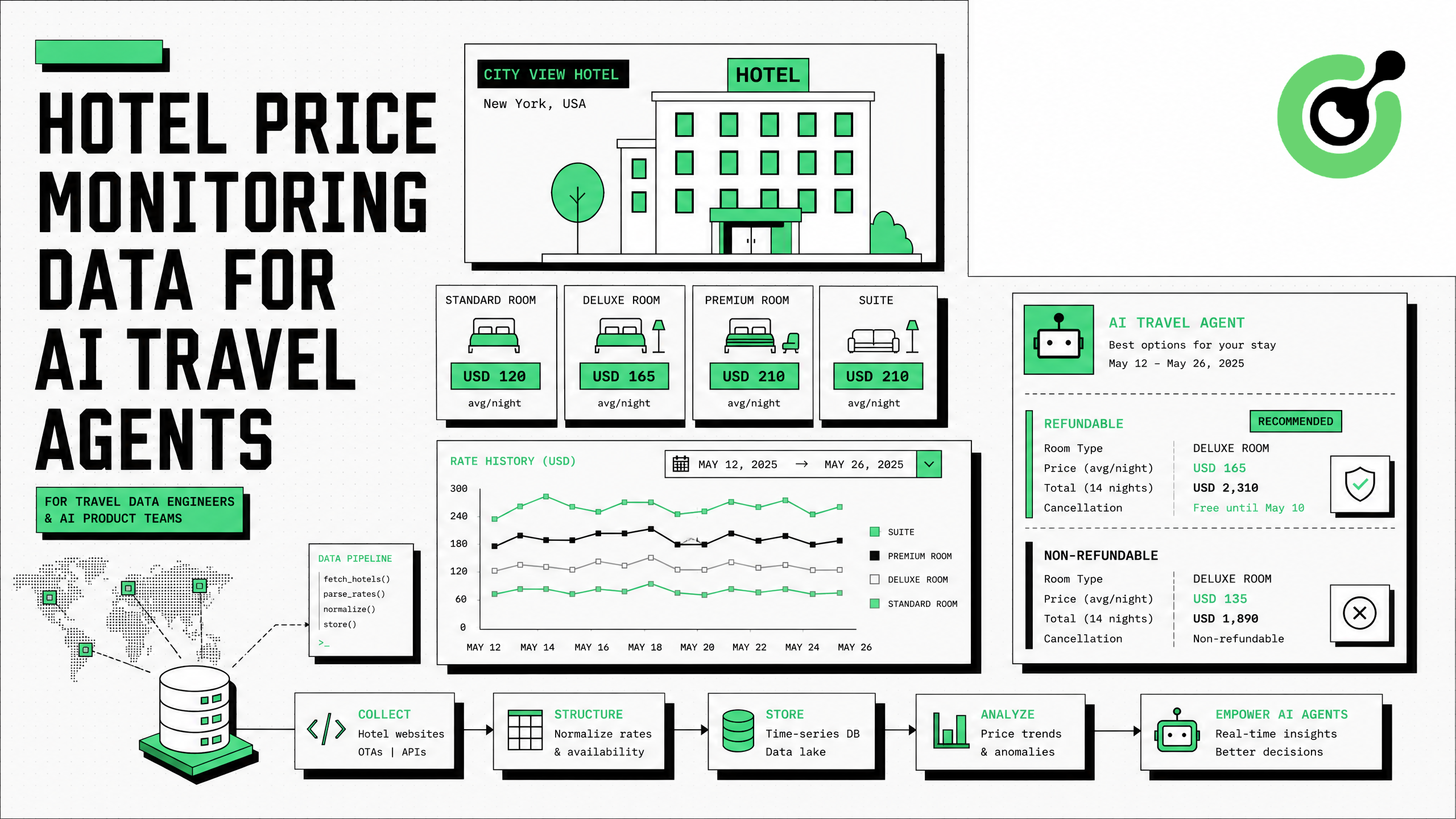
Hotel price monitoring data is only valuable to an AI travel agent when each rate is comparable, current, and traceable to its source. A displayed nightly price can omit taxes, depend on occupancy, require membership, or use a different cancellation policy from the offer beside it. The correct architecture therefore starts with official hotel and travel APIs, converts every offer into a common schema, calculates a transparent stay total, and records the collection timestamp and conditions. Authorized browser collection can fill documented gaps, but CAPTCHA recovery should remain a controlled exception rather than the primary acquisition method. This guide builds a practical monitoring pipeline for rate alerts, flexible-date recommendations, parity analysis, and itinerary planning while preserving consent, source terms, and human approval for bookings.
A rate is not comparable until the agent knows what the guest receives and what constraints apply. At minimum, capture:
from dataclasses import dataclass, field
from datetime import datetime, timezone

@dataclass
class HotelOffer:
    property_id: str
    property_name: str
    source: str
    check_in: str
    check_out: str
    adults: int
    children: int
    room_type: str
    meal_plan: str | None
    refundable: bool | None
    cancellation_deadline: str | None
    currency: str
    nightly_base: float
    taxes: float
    fees: float
    total_price: float
    rate_key: str | None
    collected_at: str = field(
        default_factory=lambda: datetime.now(timezone.utc).isoformat()
    )
The total price should represent the requested stay and occupancy. If taxes or mandatory fees are unknown, label the offer as incomplete rather than ranking it as the cheapest option.
The CapSolver web-scraping blog contains general collection patterns, and the CapSolver web-scraping FAQ covers common operational questions.
Official APIs provide explicit schemas, authentication, and commercial terms. The Sabre Get Hotel Rate Info API describes live property-rate retrieval from multiple supply sources. Its response can include average nightly rates, currency, pre- and post-tax amounts, fees, room details, meal plans, guarantee requirements, cancellation terms, and a rate key.
Google's Hotel Prices documentation defines partner resources for hotel lists, availability, rates and inventory, transactions, rate rules, queries, and date/time formats. The current Amadeus Enterprise API portal provides access to hotel-related APIs for approved enterprise customers.
| Data source | Best use | Strength | Constraint |
|---|---|---|---|
| Hotel or chain API | First-party availability and direct rates | Clear ownership and current inventory | Limited to one supplier |
| GDS or travel API | Multi-supplier rate search | Structured offers and booking keys | Contract and authentication required |
| Partner feed | Large inventory and price updates | Efficient batch processing | Partner approval and feed rules |
| Authorized public page | Validation or gap coverage | Reflects the guest-facing display | Layout changes and traffic validation |
Do not treat a partner feed as a general public endpoint. Follow the provider agreement, cache policy, display rules, and booking requirements.
Different sources return different structures. Put every source behind a small adapter that returns the same HotelOffer model.
import requests
from decimal import Decimal

class HotelRateAdapter:
    def __init__(self, base_url: str, token: str):
        self.base_url = base_url.rstrip("/")
        self.token = token

    def search(
        self,
        property_id: str,
        check_in: str,
        check_out: str,
        adults: int = 2,
        currency: str = "USD",
    ) -> list[HotelOffer]:
        response = requests.post(
            f"{self.base_url}/hotel-rates/search",
            headers={
                "Authorization": f"Bearer {self.token}",
                "Accept": "application/json",
            },
            json={
                "propertyId": property_id,
                "checkIn": check_in,
                "checkOut": check_out,
                "adults": adults,
                "currency": currency,
            },
            timeout=30,
        )
        response.raise_for_status()
        return [self._normalize(item) for item in response.json()["offers"]]

    def _normalize(self, raw: dict) -> HotelOffer:
        base = Decimal(str(raw["price"]["base"]))
        taxes = Decimal(str(raw["price"].get("taxes", 0)))
        fees = Decimal(str(raw["price"].get("fees", 0)))
        return HotelOffer(
            property_id=raw["propertyId"],
            property_name=raw["propertyName"],
            source=raw["source"],
            check_in=raw["checkIn"],
            check_out=raw["checkOut"],
            adults=raw["occupancy"]["adults"],
            children=raw["occupancy"].get("children", 0),
            room_type=raw["room"]["name"],
            meal_plan=raw.get("mealPlan"),
            refundable=raw.get("refundable"),
            cancellation_deadline=raw.get("cancellationDeadline"),
            currency=raw["price"]["currency"],
            nightly_base=float(base),
            taxes=float(taxes),
            fees=float(fees),
            total_price=float(base + taxes + fees),
            rate_key=raw.get("rateKey"),
        )
The endpoint and field mapping above represent an adapter boundary; replace them with the exact contract of your approved provider. Never invent provider fields in production code.
Price comparison errors usually come from mismatched conditions rather than arithmetic. Group offers only when they share the same property, stay dates, occupancy, room category, and rate restrictions.
from dataclasses import asdict


def comparison_key(offer: HotelOffer) -> tuple:
    return (
        offer.property_id,
        offer.check_in,
        offer.check_out,
        offer.adults,
        offer.children,
        offer.room_type.strip().lower(),
        (offer.meal_plan or "unknown").strip().lower(),
        offer.refundable,
    )


def comparable_snapshot(offers: list[HotelOffer]) -> list[dict]:
    return sorted(
        [asdict(o) for o in offers],
        key=lambda item: (
            item["total_price"],
            item["source"],
        ),
    )
Convert currencies with a timestamped source and preserve the original amount. Do not compare a refundable breakfast rate with a non-refundable room-only rate without an explicit adjustment or user preference.
The CapSolver Python scraping guide is useful when building adapters, while the CapSolver glossary can help standardize terminology across teams.
Hotel rates change by property, date, inventory pressure, and booking window. Use a policy-driven schedule instead of polling every property at the same frequency.
from datetime import date


def monitoring_interval_days(check_in: date, today: date) -> int:
    days_out = (check_in - today).days
    if days_out <= 3:
        return 1
    if days_out <= 14:
        return 2
    if days_out <= 60:
        return 4
    return 7
A production scheduler should also consider provider limits, property priority, recent price volatility, and user alert settings. Jitter job start times to avoid request bursts.
Avoid alerting on tiny currency or rounding differences. Compare the all-in total and material policy changes.
from decimal import Decimal


def detect_offer_change(previous: HotelOffer, current: HotelOffer) -> dict:
    old_total = Decimal(str(previous.total_price))
    new_total = Decimal(str(current.total_price))
    amount_change = new_total - old_total
    pct_change = (
        (amount_change / old_total * 100) if old_total else Decimal("0")
    )

    policy_changed = any([
        previous.refundable != current.refundable,
        previous.cancellation_deadline != current.cancellation_deadline,
        previous.meal_plan != current.meal_plan,
    ])

    return {
        "amount_change": float(amount_change),
        "percent_change": round(float(pct_change), 2),
        "policy_changed": policy_changed,
        "alert": abs(pct_change) >= Decimal("5") or policy_changed,
    }
The threshold should reflect the application. A corporate travel program may care about a small policy change, while a consumer alert may emphasize a larger total-price reduction.
Some approved workflows need to verify a public displayed rate or collect a field unavailable through the contracted API. Use a browser fallback only when the site's terms and your agreement permit it.
The user-provided CapSolver Agent documentation maps browser recovery to detect() and solve_on_page() in capsolver-core:
import os
from capsolver_core import Capsolver

cap = Capsolver(
    api_key=os.environ["CAPSOLVER_API_KEY"],
    default_timeout=180,
)

async def recover_rate_check(page) -> dict:
    challenge = await cap.detect(page)
    if not challenge:
        return {"handled": False, "reason": "No supported challenge detected"}

    result = await cap.solve_on_page(page)
    return {"handled": True, "result": result}
Keep the same authorized browser context, retain a conservative request rate, and stop after one bounded recovery attempt. The CapSolver CAPTCHA-solving FAQ explains the general task lifecycle, and the CapSolver troubleshooting FAQ covers common failure conditions.
Bonus Code: Use code WEBS at CapSolver Dashboard to get an extra 5% bonus on every recharge.
The AI travel agent should receive a concise, evidence-backed snapshot rather than raw provider payloads.
def build_agent_snapshot(offers: list[HotelOffer]) -> dict:
    complete = [
        offer for offer in offers
        if offer.total_price > 0 and offer.currency and offer.room_type
    ]
    complete.sort(key=lambda offer: offer.total_price)

    return {
        "query": {
            "property_id": complete[0].property_id if complete else None,
            "check_in": complete[0].check_in if complete else None,
            "check_out": complete[0].check_out if complete else None,
        },
        "best_flexible_offer": asdict(complete[0]) if complete else None,
        "alternatives": [asdict(o) for o in complete[1:6]],
        "warnings": [
            "Rates may change before booking.",
            "Verify total, availability, and cancellation terms at checkout.",
        ],
    }
Prompt the agent to explain the trade-off between price and flexibility. It should not claim that a room is reserved or that a rate is guaranteed unless the provider's booking or price-check endpoint has confirmed it.
Monitoring is read-only. Booking changes inventory, creates a financial obligation, and usually requires personal data. Keep those capabilities in separate services and require explicit confirmation before calling any booking endpoint.
| Stage | Automation level | Required control |
|---|---|---|
| Rate collection | Automated | Approved sources and rate limits |
| Normalization | Automated | Schema validation and provenance |
| Alert generation | Automated | User-defined thresholds |
| Recommendation | Assisted | Transparent comparison criteria |
| Price recheck | Automated before purchase | Fresh provider confirmation |
| Booking and payment | Human-confirmed | Authentication and explicit consent |
This boundary prevents an AI agent from turning an outdated monitoring observation into an unintended purchase.
Track property match confidence, source latency, missing taxes, currency conversion time, duplicate rate keys, parser version, and collection errors. Keep the raw provider response or an integrity hash when licensing permits. When a property cannot be matched confidently across sources, route it to review rather than merging records by name alone.
Useful metrics include successful observations per source, incomplete-price rate, median collection latency, substantive price-change rate, challenge encounter rate, and human-review volume. These metrics reveal data quality problems before they affect recommendations.
Use hotel price monitoring only with authorized APIs, feeds, websites, and accounts. Follow partner contracts, website terms, cache limits, regional consumer-pricing rules, and privacy requirements. Do not collect private reservation data or loyalty-account information without explicit consent. Minimize browser traffic and prefer official structured interfaces whenever available.
Reliable hotel price monitoring data requires more than collecting a number from a page. An AI travel agent needs normalized stay conditions, all-in totals, policy details, timestamps, and source provenance. Official hotel and GDS APIs should be the foundation; authorized browser checks can provide limited gap coverage, with CapSolver acting as a controlled recovery layer when a supported challenge interrupts the session.
Build the first approved workflow with CapSolver, then add provider-specific adapters, price-change thresholds, and a mandatory recheck before any booking action.
At minimum, store the property ID, stay dates, occupancy, room type, meal plan, refundability, cancellation deadline, currency, taxes, fees, total price, source, and collection timestamp.
Use official APIs and partner feeds first. Browser collection should be limited to permitted public pages or approved QA and validation tasks when structured access cannot provide a required field.
Use a policy based on the booking window, price volatility, provider limits, and alert urgency. Check near-term stays more frequently and distant stays less frequently.
No. Recheck price and availability through the provider immediately before booking, and require explicit user confirmation before creating a reservation or payment obligation.
CapSolver is a controlled recovery layer for supported challenges in authorized browser sessions. It does not replace provider access rights, rate limits, APIs, or booking confirmation.
Ethan Collins
AI Agent Workflow Engineer
Building clearer handoffs between AI agents and tools.
ABOUT THE AUTHOR
Learn scalable Rust web scraping architecture with reqwest, scraper, async scraping, headless browser scraping, proxy rotation, and compliant CAPTCHA handling.

Learn the best techniques to scrape job listings without getting blocked. Master Indeed scraping, Google Jobs API, and web scraping API with CapSolver.