🎉NEWCapSolver for AI agents-MCP, agent tools, and SDK integrations

Lucas Mitchell
Automation Engineer
Published Aug 07, 2026
Updated Aug 07, 2026 · min read
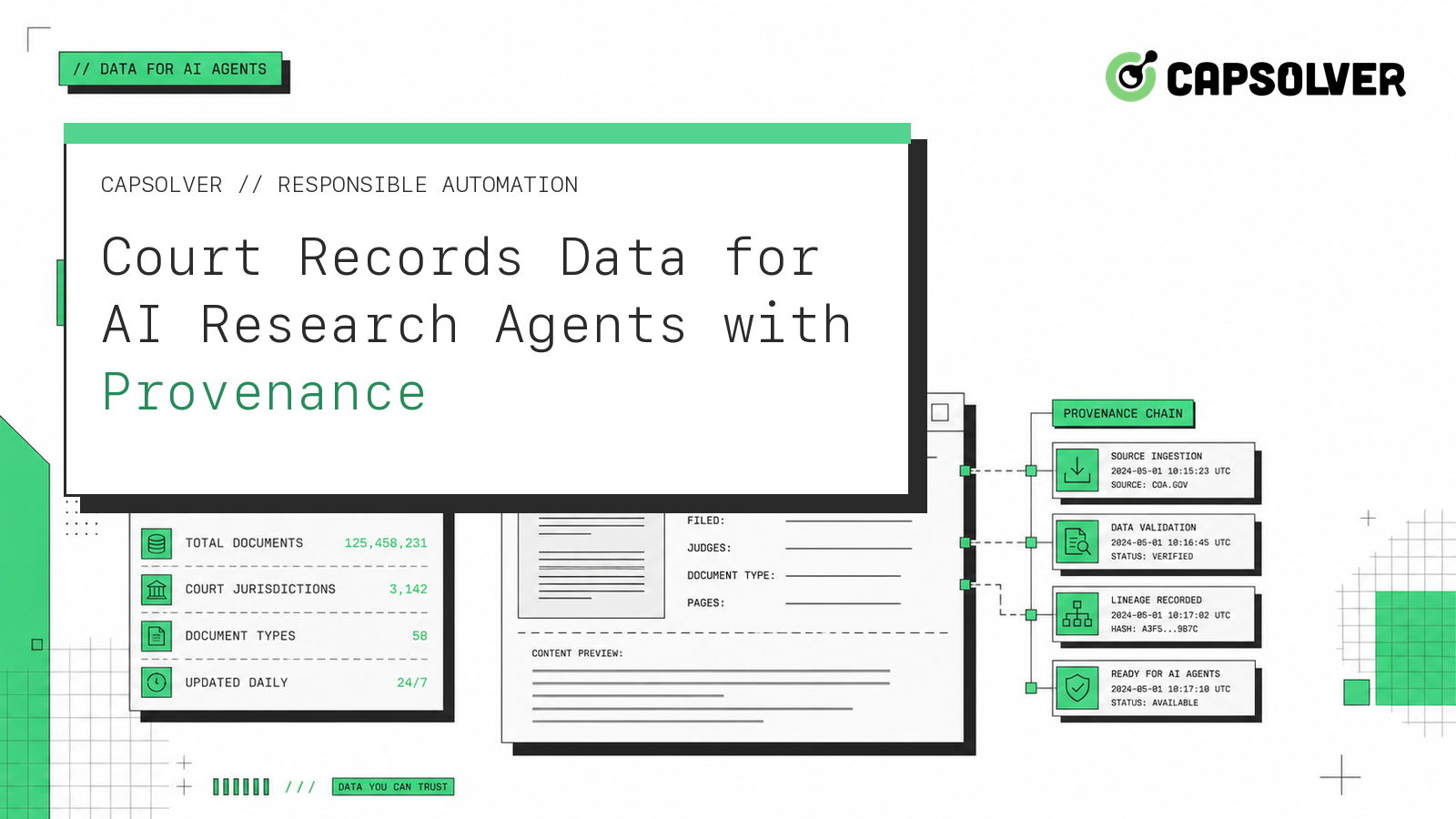
Court records data for AI research agents is useful only when every result can be traced to an authoritative court source and reviewed in context. A responsible pipeline separates acquisition from analysis, honors access fees and court rules, removes unnecessary identifiers, and never treats a challenge result as permission. CapSolver can support an authorized browser workflow when a verification checkpoint interrupts an approved retrieval, while the research system retains scope, provenance, and review controls. This guide defines a compact record model, a validation script, and finite browser-recovery rules for court records data for AI research agents. It applies to lawful public-record research and authorized accounts, not sealed, restricted, sensitive, or unauthorized material.
PACER is operated by the federal Judiciary and provides access to federal court records. Its public access description reports more than one billion documents across more than 200 federal courts. Scale does not remove record-level restrictions.
The PACER availability rules explain that sealed documents and several restricted case categories are not generally available, while public filings may have identifiers redacted. The PACER privacy and usage policy also prohibits automated collection intended to avoid billing and warns that misuse can end account privileges.
Each source should be marked public, licensed, or account-authorized. Store the governing URL and operator-approved purpose. Court records data for AI research agents should stop when the source requires a different credential, presents a sealed indicator, or exposes information outside that basis.
The data model should preserve what the source said before an AI agent summarizes it. Keep facts separate from model annotations.
from dataclasses import dataclass
from datetime import datetime, timezone

@dataclass(frozen=True)
class CourtRecord:
    court: str
    docket_id: str
    source_url: str
    access_basis: str
    retrieved_at: str
    redaction_checked: bool
    source_title: str

def normalize_record(raw: dict) -> CourtRecord:
    allowed = {"public", "licensed", "account-authorized"}
    if raw.get("access_basis") not in allowed:
        raise ValueError("stop: access basis is not approved")
    if raw.get("sealed") is True or raw.get("restricted") is True:
        raise ValueError("stop: record is not in public research scope")
    if not raw.get("redaction_checked"):
        raise ValueError("stop: redaction review is required")
    return CourtRecord(
        court=raw["court"].strip(),
        docket_id=raw["docket_id"].strip(),
        source_url=raw["source_url"],
        access_basis=raw["access_basis"],
        retrieved_at=datetime.now(timezone.utc).isoformat(),
        redaction_checked=True,
        source_title=raw["source_title"].strip(),
    )
The input is one approved source observation. The output is immutable provenance metadata, not a legal conclusion. The function stops on an unknown access basis, sealed or restricted status, or missing redaction review. This gives court records data for AI research agents a deterministic quality gate before embeddings or summaries are created.
The CapSolver AI-agent guide positions challenge handling as a recovery layer on top of an existing browser. The CapSolver quick start distinguishes token mode from browser mode. For court portals, browser mode is preferable when the approved session and page state must remain intact.
The Core SDK methods include create_capsolver, detect, get_captcha_info, solve, and solve_on_page. Put a policy wrapper around those calls: approved hostname, approved account, one attempt, and a terminal review outcome. Never use challenge handling to work around a fee, account suspension, record restriction, or rate limit.
Redeem Your CapSolver Bonus Code
Boost your automation budget instantly!
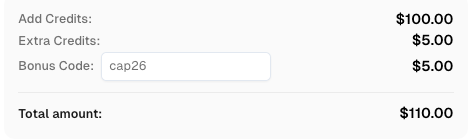
Use bonus code CAP26 when topping up your CapSolver account to get an extra 5% bonus on every recharge — with no limits.
Redeem it now in your CapSolver Dashboard
The agent tools layer offers get_all_tools, create_executor, and solve_captcha for an LLM-callable boundary. The MCP service layer offers solve_captcha, detect_captchas, get_balance, and get_supported_captchas for MCP-compatible clients. Court records data for AI research agents should expose only the minimum tool set required by the approved run.
Stage one records the original docket metadata and source URL. Stage two removes unnecessary personal information, resolves stable identifiers, and adds a content hash. Stage three lets the research agent extract claims, but every claim must point back to a source record and page or docket entry.
NIST’s AI Risk Management Framework encourages governed, measured, and managed controls. For court records data for AI research agents, practical evidence includes access-basis logs, redaction decisions, sampling accuracy, correction history, and reviewer identity.
Do not infer that a missing record is adverse, that a name match identifies a person, or that an old allegation is a current fact. Stop for legal or editorial review when identity resolution is uncertain, the docket changed after retrieval, a record was removed, or a model-generated summary cannot cite the underlying filing.
Court records data for AI research agents should preserve provenance before it produces insight. Respect the court’s access model, keep retrieval separate from interpretation, minimize personal data, and make ambiguous identity or restriction signals terminal. When an authorized browser session needs bounded challenge recovery under those controls, CapSolver can support the approved checkpoint.
Store the court, docket identifier, source URL, access basis, retrieval time, redaction status, and source title.
No. Sealed, restricted, sensitive, or otherwise unauthorized records are outside scope.
Use one justified attempt per checkpoint and stop for review after any failure or scope change.
No. A summary is an annotation and must remain traceable to the authoritative source record.
Lucas Mitchell
Automation Engineer
Helping browser automation recover and continue.
ABOUT THE AUTHOR
Learn scalable Rust web scraping architecture with reqwest, scraper, async scraping, headless browser scraping, proxy rotation, and compliant CAPTCHA handling.
Learn the best techniques to scrape job listings without getting blocked. Master Indeed scraping, Google Jobs API, and web scraping API with CapSolver.