🎉NEWCapSolver for AI agents-MCP, agent tools, and SDK integrations

Ethan Collins
AI Agent Workflow Engineer
Published Aug 07, 2026
Updated Aug 07, 2026 · min read
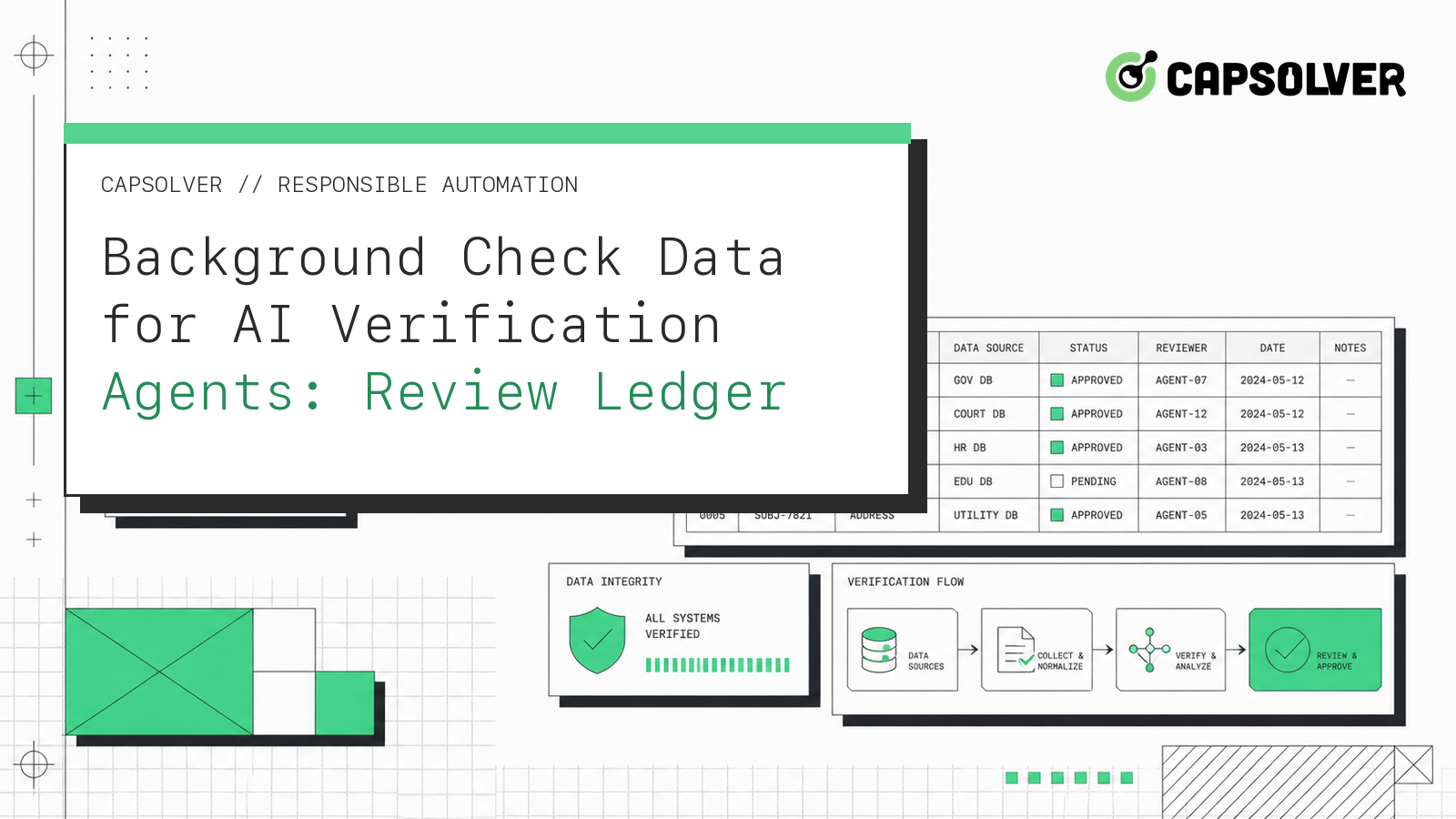
Background check data for AI verification agents is a high-impact workflow, so the safest architecture is a review ledger rather than an autonomous decision engine. The system verifies purpose and consent, acquires only authorized evidence, records provenance, highlights ambiguity, and hands any consequential interpretation to a trained reviewer. CapSolver can support a permitted vendor or QA browser session when a verification checkpoint interrupts the approved process, but it does not change legal duties or data rights. This guide shows how to model evidence, enforce terminal stop conditions, and keep challenge recovery separate from screening decisions. It is not legal advice, and it excludes private, restricted, sensitive, or unauthorized data.
The FTC’s Fair Credit Reporting Act overview explains that consumer-report information may be provided only for purposes specified by law and that users have duties when adverse action relies on a report. Background check data for AI verification agents therefore needs a purpose gate before any source or tool is available.
For employment use, the FTC’s employment background-check guidance outlines disclosure, authorization, pre-adverse action, and post-adverse action responsibilities. The EEOC’s arrest and conviction guidance also warns against discriminatory use of criminal-history information.
Require a job ID, documented purpose, subject authorization status, source contract or public-access basis, reviewer group, and retention policy. If any input is absent, the run returns STOP_NO_BASIS before navigation.
A review ledger prevents the original evidence from being overwritten by an agent summary. Background check data for AI verification agents should preserve both.
from dataclasses import dataclass, field
from datetime import datetime, timezone

@dataclass
class ReviewLedger:
    job_id: str
    permissible_purpose: str
    authorization_confirmed: bool
    source_url: str
    subject_match_basis: list[str]
    retrieved_at: str = field(default_factory=lambda: datetime.now(timezone.utc).isoformat())
    dispute_status: str = "unknown"
    agent_summary: str = ""
    human_disposition: str = "pending"

def open_review(raw: dict) -> ReviewLedger:
    if not raw.get("permissible_purpose"):
        raise ValueError("stop: permissible purpose is missing")
    if raw.get("authorization_confirmed") is not True:
        raise ValueError("stop: required authorization is not confirmed")
    if len(raw.get("subject_match_basis", [])) < 2:
        raise ValueError("stop: identity match is too weak")
    if raw.get("dispute_status") == "open":
        raise ValueError("stop: disputed evidence requires specialist review")
    return ReviewLedger(**raw)
The input is a scoped job and evidence metadata. The output is a pending review record, never an automatic employment, housing, credit, or insurance decision. The function stops on missing purpose, missing authorization, weak identity matching, or an open dispute.
The CapSolver AI-agent architecture treats challenge handling as recovery within an existing authorized workflow. The CapSolver quick start describes token and browser modes. A controlled vendor portal usually needs the browser path so the approved session and audit context remain together.
The Core SDK reference documents create_capsolver, detect, get_captcha_info, solve, and solve_on_page. Wrap any use with an approved-host check, a job-purpose check, a one-attempt counter, and a terminal human-review branch. Stop on a changed account role, new data category, consent mismatch, rate restriction, or repeated challenge.
Redeem Your CapSolver Bonus Code
Boost your automation budget instantly!
Use bonus code CAP26 when topping up your CapSolver account to get an extra 5% bonus on every recharge — with no limits.
Redeem it now in your CapSolver Dashboard
The CapSolver agent tools provide get_all_tools, create_executor, and solve_captcha when the orchestrator uses function tools. The CapSolver MCP service provides solve_captcha, detect_captchas, get_balance, and get_supported_captchas for MCP clients. Tool output must return to the acquisition component, not directly to the component that recommends a disposition.
Background check data for AI verification agents needs a dispute-aware lifecycle. When a subject contests a record, freeze downstream recommendations, preserve the contested version, attach the dispute time, and route the issue to the responsible provider or reviewer. Do not ask the agent to resolve identity from web search snippets.
The CFPB’s background screening explanation describes consumer reporting uses and the subject’s ability to dispute inaccurate or incomplete information. Build correction propagation into every cache, embedding index, and reviewer view.
NIST’s AI Risk Management Framework supports governed and measured controls. Track false matches, stale evidence, unresolved disputes, reviewer overrides, demographic outcome differences, missing notices, and records retained past policy. Aggregate accuracy alone can hide the cases that matter most.
The reviewer needs the original evidence, the agent summary, match basis, freshness, dispute state, and applicable workflow notice. The interface must allow approve, reject, request correction, or stop. A human who can only confirm the model is not a meaningful safeguard.
Background check data for AI verification agents should create inspectable evidence, not automatic adverse conclusions. Verify purpose and authorization, separate evidence from summaries, freeze disputed records, measure false matches, and give reviewers genuine decision authority. When a lawful vendor or QA session needs tightly bounded challenge recovery, CapSolver can serve that checkpoint without entering the decision layer.
The safer design uses the agent to organize evidence and requires an authorized human to make consequential decisions under applicable law and policy.
Store purpose, authorization, source provenance, retrieval time, identity-match basis, dispute status, agent summary, and human disposition.
Freeze downstream recommendations, preserve the disputed evidence, and route the issue through the required correction process.
No. It may resume only the original authorized step and must stop before any private, restricted, sensitive, or unauthorized data.
Ethan Collins
AI Agent Workflow Engineer
Building clearer handoffs between AI agents and tools.
ABOUT THE AUTHOR
Learn scalable Rust web scraping architecture with reqwest, scraper, async scraping, headless browser scraping, proxy rotation, and compliant CAPTCHA handling.

Learn the best techniques to scrape job listings without getting blocked. Master Indeed scraping, Google Jobs API, and web scraping API with CapSolver.